- Jul 31, 2025
Why “Functional Training” Is B.S.
- TimeSaver Strength
- 0 comments
You’ve probably heard of “functional training” — the idea that exercise should mimic real-life movements or sport-specific tasks to improve how you perform in everyday life or on the field. It’s a popular buzzword in gyms, especially among trainers looking to sell novelty. But here’s the truth: functional training is mostly B.S. — a distraction at best, and in some cases, counterproductive and even harmful.
The Illusion of “Transfer”
One of the core assumptions behind functional training is that strength or skill developed in a gym will somehow “transfer” to performance outside of it — your tennis backhand, your golf swing, how you pick up your grandchild, or how you avoid injury on a slippery sidewalk. That sounds logical — but it’s a misunderstanding of how motor learning and strength development actually work.
In reality, skill transfer is not a thing. The nervous system is highly specific in its adaptations. Practicing a movement that looks similar to a sports skill does not make you better at that skill — it just makes you better at the training version. The further you stray from the actual performance conditions of your sport or daily activity, the less relevant the adaptations become.
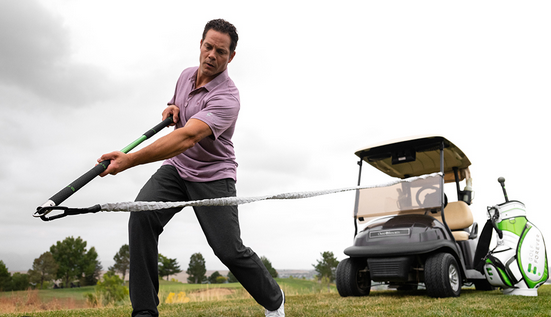
Take golf, for example. A common “functional” drill is to swing with a heavier club to “build strength and speed.” But this doesn’t transfer — in fact, it interferes. As Garry Bannister and others have pointed out, introducing heavier or altered tools rewires your nervous system away from the exact motor pattern you’re trying to refine. The result? Your timing, rhythm, and mechanics degrade — and you increase your risk of injury.
Skill and Strength Are Separate — Keep Them That Way
If you want to get better at your sport, practice your sport under conditions as close to competition as possible. That means the same environment, the same tools, and the same intensity. Don’t dilute skill development with pseudo-functional exercises that trick you into thinking you’re improving.
And if you want to get stronger? Train for strength. Use exercises that are safe, repeatable, and loadable — like controlled compound movements that allow you to push your muscles to the limit and stimulate meaningful adaptation. That means intensity, progressive overload, and enough recovery — not standing on a Bosu ball with a kettlebell doing circus tricks.
Why My Program Works for Athletes
This is exactly why my program is so effective for improving athletic performance — without pretending to be “sport-specific.”
I train clients using brief, intense, full-body workouts that safely and efficiently build the strength, muscle, and resilience that athletes actually need. Stronger muscles support joints. A stronger nervous system improves coordination and stability. A stronger body recovers faster, resists fatigue longer, and performs better under pressure.
You don’t need to swing a weighted bat, or jump around in unstable positions to improve your game. You need more force production, better fatigue resistance, and a stronger engine behind the skills you’ve already built. That’s exactly what my training delivers.
My clients — from recreational athletes to older adults — move better, feel better, and perform better, not because we mimic sport movements, but because we build the raw capacity their sport demands.
The Bottom Line
If your goal is to get stronger, build muscle, move better, or play your sport more effectively — ditch the functional training nonsense.
Train strength with intensity and focus.
Practice your sport as your sport — not in disguise.
Don’t mix skill development with strength work.
And stop chasing novelty when you should be chasing results.
Real function doesn’t come from mimicking movement. It comes from building capacity. And that means strength training done right — not “functional training” done wrong.